
31. August 2012

Civil society in Russia: Meeting of Parliamentary Working Group in St. Petersburg
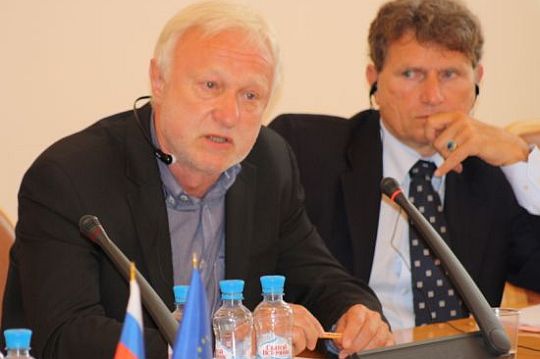 The omens were not good for the second meeting of the Working Group of the EU-Russia Parliamentary Cooperation Committee (PCC), held at St. Petersburg's Legislative Assembly on 30-31 August. The August skies above the city were grey, heavy with clouds, and temperatures were distinctly chilly for late summer. Even more discouraging, though, were the new laws and amendments the Duma had approved in the final weeks before its summer break, severely curtailing the rights of civil society and the extra-parliamentary opposition. So, the choice of the topic for the meeting of EU parliamentarians and their colleagues from the Duma and the Federation Council was an apt one: civil society in the EU and in Russia. (Image: W. Schulz and M. Pulch, EEAS Moscow)
Given the events of the previous months and, above all, the scandalous ruling against the punk band Pussy Riot, a certain tension in conjunction with this topic was inevitable.
Meetings with LGBT associations and the diplomatic corps
On the evening of the 29th, before the actual working group session began, some MEPs and EU delegation representatives met with representatives of the homosexual movement (LGBT), which is regarded as having a stronghold in St. Petersburg. Individuals from Vikhod, LGBT Network and the "Bok Obok" festival described the concrete impacts of the new law banning "propaganda of homosexuality", which was first adopted in St. Petersburg and has since come into force in seven other regions. The European visitors heard that holding demonstrations has become virtually impossible, about increasing restrictions against assemblies and events, including festivals, and how the police fail to act upon the only too-frequent reports of attacks by nationalists and rightwing extremists against participants of LGTB events.
The atmosphere has deteriorated markedly over the past five years, NGO representatives said. Russia's Supreme Court upheld the new law on 3 October as the final court of appeal. Now only Strasbourg's Court of Human Rights has the authority to question its validity. They also spoke of enormous pressure from the Orthodox Church to push the legislation through. A draft for a national law had already been presented to the Duma, though it was not being pursued at that time. No support was forthcoming, they said, even from the deputies of the Duma party Just Russia, which has taken a somewhat more liberal stance of late. Their recommendation to the EU was to keeping putting the issue on the agenda and demonstrating support, including through active participation in festivals of that kind.
Subsequently, there was a meeting with representatives from the St. Petersburg-based consulates and embassies. More than a dozen consuls general attended that gathering, which focussed on EU-Russian relations. There was definitely a sense of helplessness in the air, related to the events of recent months and President Putin's governing style. There was not always consensus. Some of those present adhered to the long familiar formula of "change through trade" and believed Russia to be on the right path, which had simply turned out to be more arduous and longer than expected. Other ambassadors were certain that the EU must voice clear criticism of the situation in Russia and, in particular, consistently promote EU values if the two sides are to come closer together in the long term. Economic relations would not suffer at all as a result according to the British consul, who cited the United Kingdom as an example. There was consensus on the view that the situation of civil society varied greatly from one region to the next, with considerably less scope for active citizenship allowed outside of the major cities.
Open criticism from NGOs and the EU side
There were also more than a dozen civil society representatives among those attending the actual meetings in the Tauride Palace, the seat of the Interparliamentary Assembly of the CIS, not far from Smolny Cathedral. Once the chairs had made their introductory remarks, discussion quickly turned to the Pussy Riot case, a prominent example of the shocking way Russian judicial authorities treated any form of protest. In comment after comment, MEPs affirmed that they regard the new laws as restricting the freedom of citizens and see them as steps in the wrong direction. One of my colleagues from the Netherlands, Omen-Ruijten, pointed out that economic growth and a flourishing society are possible only in a country where the rule of law is upheld, adding that the state should promote civil society rather than impede it, since, as our PCC Co-Chair interjected, civil society makes a state stronger and, as the Polish MEP Migalski added, that extends to free media and free elections as well.
I emphasized once again the essence of civil society, which implies both emancipation and participation. Hannah Arendt and Jean Paul Sartre coined the term after World War II, to draw a distinction from totalitarian society. Sitting together at a round table, as in Poland in the '80s, but also in the present day, at Stuttgart 21 for instance, were examples of successful and constructive dialogue.
We were primarily supported by the deputies of the Duma party "Just Russia".
Ms Dimitrieva (foto) emphasized that her fraction alone had supported the demonstrators, while no one else did. She related how her party had cooperated with the civic network Citizens Watch in St. Petersburg to monitor the parliamentary and presidential elections, observing flagrant violations. The judicial dispute was still ongoing. She described the prevention of construction by an energy company of an 80m building in central St. Petersburg as an example of successful civic initiative. Explaining that buildings taller than 40m are actually prohibited due to the city's World Cultural Heritage status, she reported that the affair had even forced the then governor to resign. Now though, they faced a new challenge in the form of the planned 500m tall Gazprom Tower in a St. Petersburg suburb.
Present during the discussions were civil society representatives from Citizens Watch, multiple children's and youth organizations, a regional environmental organization, Memorial St. Petersburg and a representative of the EU-Russia Civil Society Forum. All of them were all able to cite individual examples taken from their daily activities to demonstrate ways in which the state was interfering with their work by setting ever more extensive and restrictive requirements. A central source of annoyance and concern for all was the interpretation of the new NGO law, which enters into force in November, and the term "foreign agent" as its most essential component. It is, they said, as yet unclear what criteria will define the distinction between non-politically active and politically active NGOs, the latter of which fall under the law. My colleague Fleckenstein (image, with André Klimov) was able due to his own experience as chairperson of a charitable association to report that social work can rapidly become political when the adoption of new social in the Bundestag is at stake.
The justification of the legislation's initiators
The co-chair of the PCC, André Klimov, a co-author of the controversial legislation, attempted to respond to the criticism by relating how terrorist Islamic organizations in South Russia had exploited NGO status or how he himself had been attacked and libelled by a British company posing as an NGO during his re-election campaign. He did not see anything disrespectful in the term "agent", since there are also bank and insurance agents, and he relativized the significance of the legislation further, pointing out 80% of NGOs were not affected by it and it did not cover all NGOs which receive foreign monies. He noted in addition that it was, of course, still possible to receive foreign funding.
I responded that numerous of Russian NGOs were dependent on funding from outside Russia because the Russian state refused to provide them with any sort of support. My colleagues also emphasized that the text of the law was too vaguely worded and open to abuse. When there is no dialogue with civil society and the opposition, parts of the opposition are driven toward radicalism, as Germany's experience with the RAF in the late 1960s demonstrated.
At the conclusion of the meeting Duma Deputy Speaker Sergey Zheleznyak, who is also a PCC member, was asked to explain the pending expulsion proceedings for Gennady Gudkov the deputy of the Just Russia fraction. Zheleznyak emphasized that these were purely formal proceedings, since Gudkov appeared to have violated the separation of parliamentary duties and business activities. Zheleznyak was unable to explain, however, why the procedure had been initiated at that particular time or why it affected only Gudkov, one of the few deputies to have supported the demonstrators, referring questions to the competent committee, which would be addressing the case in early September.
On the evening of the first day another informal meeting was scheduled, at which trade unionists and members of several local civic associations, as well as researchers, essentially confirmed what we had learned about the situation and impressions we had received in the course of that day and through the media earlier on.
Our visit was important, to allow us to gain a picture of the problems and the work of the NGOs on the ground and to make new contacts. The representatives of civil society were pleased to see so much interest and support from the EU and that the problematic laws were being followed with such a critical eye in the EU. We managed to communicate clearly to our Duma and Federation Council colleagues that these new restrictions are not acceptable under any circumstances and that we could not accept practices that violated international standards.
The events of the past months have made it clear that the EU needs to rethink its policy towards Russia, the ways it views the situation. At the present, we do not share common values or common objectives with the Kremlin elite. We need to bring a new openness and honesty with regard to our relationship to Russia and regarding what we can and should expect.