
30. November 2012

Statement in support of presenting the Luther Award “Das unerschrockene Wort” to the Russian women’s punk band Pussy Riot
represented by Nadezhda Tolokonnikova, Maria Alyokhina and Yekaterina Samutsevich
1. The band’s formation and name
The members of Pussy Riot, the Russian women’s punk band, met at protest events in Moscow, where they demonstrated for freedom of assembly, free and fair elections, gender equality and protested discrimination against homosexuals or the clearing of trees in Khimki Forest. At the time, events of this kind in Moscow drew only hundreds of protesters, not the tens of thousands seen more recently. In September of 2011, an opposition event was held at a rest facility outside of Moscow. Future leaders of the opposition were among those present, such as Garri Kasparov, Alexei Navalny and Boris Nemtsov. So were the women who would become Pussy Riot. It was there that they decided to form the band, in reaction to the blatant and unscrupulous castling move at the Kremlin, the job-swap between Dmitry Medvedev and Vladimir Putin. The women’s aim was to raise awareness of the threat of a return to autocracy. For those who had been hoping for change, the announcement and the realization that it had all been settled in advance struck like a hammer blow: Medvedev, nothing but a seat-warmer, “vice president” at best, and all his pronouncements on modernization and political reform merely smoke and mirrors. It is worth noting that when Medvedev came to office, all of the young women in Pussy Riot marched into St. Petersburg police stations to take down the portrait of Putin and replace it with Medvedev’s. The great hope was that Russia’s “managed democracy” would give way to an unconstrained and authentic democracy. But the prospect of another twelve years of Putin after the past twelve years of Putin, of a Putin era longer than that of Leonid Brezhnev, served to rescind the social contract in place until then – “We provide for high consumption and you leave us to govern undisturbed” – triggering a wave of protest by civil society foreseen by none. Like many, Pussy Riot thought it unlikely that Russia would be led by a Putin 2.0 in the president’s third and fourth terms, as had been suggested. Far more probable was a Putin III, who would go to any lengths in his efforts to safeguard his own power, accumulated fortune and business empire, and those of his cronies.
Another impetus for the band’s formation was the “Arab Spring” and, with it, the painful recognition that the courageous women on Tahrir Square were being shifted further and further into the background as events unfolded and would ultimately lose out. In another deeply patriarchal society, Pussy Riot wanted to make their stand before it was too late. In no European country is the political arena as male as it is in Russia. That is why Pussy Riot stands up for women’s right to self-determination and tries to punch holes in the still-prevailing gender role clichés with their actions. Pussy Riot is out to prove that women are also capable of daring deeds, that they are not the “weaker sex”.
Pussy is an English word used by men as a derogatory term form women. By using it in their name, the band is hurling it back in the teeth of its speakers. Mösenaufruhr [pussy riot/uproar] – the intrinsic protest is clear. One who understands the words, and wants to understand, might also say Frauenaufstand [women’s uprising]. Entirely in the spirit of Martin Luther, Pussy Riot listened to the speech of men and appropriated the offensive word as their own, thrusting it back like a spear at conventional sexist vocabulary. In a society where male sexism predominates and homophobia and misogynistic tendencies are proliferating, it cannot hurt, now and again, to emphasize the inherent rights of women and their sex organs in radical and bold terms. In the cruder men’s scene in Russia, there are terms of a quite different calibre in circulation. Here in Germany too, by the way, as everyone knows. President Putin, in his unambiguously sleazy style, has said that he would not take this name, this thing, in his mouth. The same Putin who, in his televised talk after the falsified Duma elections, said that he saw the white ribbons of the protest movement as condoms. Who, during the Georgian conflict, announced that President Saakashvili should be hung by the balls. This last one of the KGB’s favourite torture techniques. A note written by Stalin, dated 5 April 1930, was found attached to a caricature by Valery Mezhlauk depicting an event of this kind: “To the members of the PB [Politburo]. For all sins, past and present, hang Briukhanov by the balls. If his balls hold out, consider him acquitted by trial. If they don’t hold, drown him in the river. I[osif] St[alin].”
Pussy Riot is the stinging defence against this crude, obscene macho language, in which the women are reflecting the language back to its speakers like an echo. Odd, isn’t it, that it is primarily when women begin using this language to attack this widespread chauvinism that the indignation of men sets in. Readings of Vagina Monologues, such as the one at the European Parliament, which attacks hidebound thinking and gender clichés and expresses the conscious emancipation of modern women in the 21st century met with great success. Enough said about the band’s formation and name.
2. Appearances and events
Every one of Pussy Riot’s actions and performances so far has been a test of courage, intended to free them from the fear of state’s power. One of their first audacious performances was held on 14 December 2011 in front of a detention centre where demonstrators who had protested the falsification of the Dec. 4th Duma elections were being held. “Death to prison, freedom to protest” they sang. For the most part, their performances in the underground or on Red Square were quite short, to avoid playing into the hands of the bulldogs from the OMON police unit. Videos of their actions were then posted on the internet, mass-media-friendly screenshots of a moment in time. Pussy Riot’s performance on Red Square packed a forceful symbolic punch and won a place for these women in a long line of courageous Russian women. It is no coincidence that women are often at the head of movements against dictatorship and for democratic renewal, particularly in patriarchal and authoritarian regimes: it is they who have the most to gain. Strictly speaking, it was not the sailors, but Petrograd’s female textile workers who kicked off Russia’s February Revolution in 1917 with a hunger revolt. Generations of dissident Soviet women followed in their footsteps, such as Lydia Chukovskaya, Yevgenia Ginzburg or Lyudmila Alexeyeva. In 1968 Larisa Bogoraz and Natalya Gorbanevskaya, both the mothers of small children, unrolled banners protesting the Red Army’s march into Prague at a former execution site in front of Moscow’s Kremlin. Their arrest followed within a matter of seconds. On that midsummer day, those dissidents wore their winter clothes, ready for the penal camps of Siberia. At that same execution site, Pussy Riot wore short summer dresses in winter. A brave signal indicating that they had overcome the fear of deportation, the fate of their predecessors. Courage is a prerequisite and key virtue for someone who wants to be taken seriously in Russian culture, where any act of intervention might be met by earthy language and unpredictable violence. Putin uses a huge deployment of media resources to cultivate his image as a fearless superman, who pilots military aircraft and submarines, throws his opponents to the mat, hugs tigers, dives for sunken treasure, steers a motorized hang-glider to lead a flock of young cranes in flight disguised as a surrogate parent and tosses out pithy remarks. Yet in January of this year, when a hundred thousand people flooded the streets in Moscow to demonstrate against him, Putin went into something like a state of shock. Pussy Riot was rubbing salt on that wound, this display of weakness by the frightened ruler, when they gyrated on Red Square in front the Kremlin, saucily jeering “Putin wet his pants!” a fear-induced incontinence being seen as the most derisory of all symptoms of cowardice, and not just in Russia.
Pussy Riot did not set out to become world famous; it was the Russian state, once again, which thrust three young women to fame by its refusal to engage in dialogue and its policy of categorical repression. This has happened to many dissidents and artists over the years: most recently, the author and Nobel laureate (1987) Joseph Brodsky. To paraphrase Anna Akhmatova, the authorities fashioned quite a “biography” for him in the 1964 trial against him. The three women from Pussy Riot have lost their anonymity, but they have also put a face on modern creative Russia, on the young protest movement. Speaking for the band, Yekaterina Samutsevich, the Pussy Riot activist on probation, has vehemently refuted the suggestion that they were seeking fame and has turned down offers to give concerts in Berlin, London or New York that would have meant a great deal of money. She continues to see her role as that of furthering the Russian protest movement, despite the terms of her probation.
3. Artistic influences and claim to artistic status
Pussy Riot engages in political performance art and belongs in the tradition of the Russian Avantgarde. They see themselves as pupils and successors of the poet Alexander Vvedensky and his “bad rhyme” principle. A member of OBERIU (“Association for Real Art”), Vvedensky, who rebelled against conformity and timidity with provocative output, fell victim to the Stalinist Terror in 1941. Pussy Riot was strongly influenced by Moscow Conceptualism, a Soviet artistic movement from the 70s and 80s which used irony to expose the ossified authorities. It is the art of generating attention in times when freedom is suppressed. When this kind of art causes allegedly “flawless” democrats to reveal their true faces, it has fulfilled its purpose. Not long ago, a Russian magazine declared Pussy Riot the year’s best art project, because the band embodies a refreshingly creative and current culture of protest. In early January the punk- band is supposed to receive the "1Live- Krone” award of [the German public broadcaster] WDR, because, according to WDR, it belongs in the tradition of protest artist such as Bob Dylan and the Sex Pistols. A large Joseph Beuys exhibition is now showing in Moscow. That pioneer of political performance art would have delighted in Pussy Riot’s uncompromising struggle on freedom’s behalf. After all, the Pussy Riot case came close to drawing greater international attention and response than all the protest demonstrations, human rights violations and murders of journalist of the past years combined. The religious, political, legal and moral aspects involved are the subject of vibrant debate in Germany and elsewhere.
The colourful crocheted balaclavas are visually striking. An artistic idea that endows a certain protection by providing anonymity while also ensuring that the women’s faces do not distract attention from the message. As Pussy Riot describes it: “the incognito protected by masks is intended to lend the assertion of emancipation something beyond the personal.” These bright balaclavas have become a global symbol of courageous resistance against the dictatorial regime. Creating a political label which is understood over such a huge territory is an art in itself. Few have managed it before. The group has spoken out clearly against its commercial exploitation, though it is practically inevitable and is already underway all over the world without their consent. No one ever consulted Che Guevara about putting his face on a T-shirt either.
Politically, Pussy Riot draws inspiration from the feminist views of Judith Butler, who was recently awarded the Adorno Award at Frankfurt’s Paulskirche. They also feel a connection to the ideas of the anarcho-individualists, who stress the autonomy of the individual, reject violence and advocate education rather than revolution as the way forward.
Musically, Pussy Riot is committed to punk and see themselves as influenced by Nina Hagen and the Riot Grrrl bands of the US. Punk because, as a form of rebellious expression, it formulates its critique of the political system with radical bluntness. Our own peaceful, Protestant revolution benefited from that as well. For unlike in the West, in the GDR punk was a reaction to a society of scarcity [Mangelgescellschaft], undersupplied in terms of both elementary freedoms and material goods. The punks in the GDR were trying to surmount the restrictions of the totalitarian system, which aimed at having direct control over every aspect of the lives of young people, a control the punks refused to permit. Their garish appearance and the non-conforming extravagance of their activities resulted in their classification as negative and decadent. Ergo: they were enemies of the state, relentlessly persecuted, and often landed in jail.
Perhaps it needs to be explicitly stated in Wittenberg once more that it was not a single act of beating a sword into a ploughshare that set off the GDR’s peace and protest movement , but the many young people in earlier years who wore the “Swords to ploughshares” patches designed by Harald Bretschneider on their biker’s cut-offs and punk jackets. The “blues masses” and punk concerts in Berlin, Leipzig and Halle filled the churches long before the big Monday demonstrations did so. One need only recall the legendary Die Firma and Element of Crime concert on 17 October 1987 in Berlin’s Zionskirche, which was invaded by inebriated skinheads intent on “mixing it up”, which brought to light a neo-Nazi scene that had been tolerated until then. Many punks were actively involved in the organization Kirche von Unten (Church from Below) and reported serious grievances at prayer gatherings. Certainly, punks did not bring about the collapse of the DDR’s disciplinarian regime. But they did contribute to making it impossible to uphold the system by 1989. Perhaps these brief remarks about punk music and this artistic movement can help engender some respect. Because when Heiner Friedrich List of Allianz der Bürger für Wittenberg [Citizens’ Alliance for Wittenberg] says
What does that have to do with art? Showing up in a church, covered in a hood, hopping around like you’re cracked, and screaming insulting words – It has nothing to do with art. It is scandalous, that is what it is! People like that quite simply belong in prison!
he is, of course, revealing only a nasty knee-jerk urge to punish and a lack of understanding of art. Undoubtedly, opinions about music do vary. Martin Luther, for one, believed that music drives away the devil. Which, in the case of punk music, does have a certain plausibility from an acoustic standpoint. Only an ignoramus perceives it as hooliganism.
4. Charges of blasphemy and injuring religious sensibilities
Pussy Riot became world famous for their sensational punk prayer in Moscow’s Cathedral of Christ the Saviour and the subsequent prosecution of three of the women involved. For around 20 seconds, the women of Pussy Riot kneeled and made the sign of the cross; their prayer in front of the iconostasis went on for a total of around 40 seconds before they were forced away by the guards; several days later, they were arrested. A video of the event shows that the only people in the church at the time were a few guards and the ladies who stock up the sacrificial candles and that hardly any singing, or at any rate hardly any audible singing actually occurred. The widely disseminated video, which is several minutes long and has subtitles providing the now well-known text, is a montage of scenes from this performance and from an earlier performance in a different church. In order to asses it, one ought to consider the entire text rather than look at scraps from it taken out of context. To that end, here is a fairly literal translation:
Mother of God, o Virgin, drive out Putin!
Drive out Putin, drive out Putin!
Black priest’s robes, golden epaulettes,
Parishioners crawl to bow down.
Freedom’s ghost in heaven
Gay-pride parade sent to Siberia in shackles
The KGB’s boss is their highest saint,
He leads droves of protesters to jail
Lest the holiest of all be distressed,
Women must make babies and love.
Shit, shit, godly shit! Shit, shit, godly shit!
Mother of God, o Virgin, become a feminist,
become a feminist, become a feminist!
The church praises festering leaders,
The Cross Procession is made up of black limos.
A predicant is on his way to your school,
Go to class and give him money!
Patriarch Gundyay believes in Putin –
Would do better, the dog, to believe in God!
The Belt of the Holy Mother is no substitute for demonstrations
The eternal Virgin Mary is with us at our protests!
Mother of God, o Virgin, drive out Putin!
Drive out Putin! Drive out Putin!
The women used rhetoric, lexis and strophes reminiscent of the litany of prayer to create a prayer in the aspiration form with political content. It is not a manifesto, its strength lies in the convergence of location and content. They took the protest movement’s slogan “Rossiya bez Putina” (Russia without Putin), heard throughout Moscow in the run-up to the presidential election, and brought it to the right place at the right time. The fact that it is not unusual to hear someone who feels weak or helpless pray to Maria, the Mother of God, to help deliver them from evil or evil men, added additional force. As occurred during the periods of terrible tsarist rule or after the October Revolution, when the Bolsheviks destroyed religious buildings or converted them to other uses and persecuted and murdered priests and believers.
The video posted in the Internet and the accompanying text, which describes the political motives of the punk prayer, is not ambiguous and hardly apt to offend religious sensibilities. There was also no disturbance of the peace, because no services were being held at the time. They certainly did disturb the peace of the rulers of Russia. Alone the fact that the women entered the area in front of the iconostasis is considered scandalous by the priests, although this is a faux pas met with leniency when tourists make it. The iconostasis was not the backdrop, though, the political background for the punk prayer service (pankmoleben) provided that. Had they sung “O Virgin, watch over Putin!”, there would have been no consequences, it is certain. What they did though, was call on the Mother of God to drive Putin out and castigate the patriarch for failing to pursue his true mission. Just who was being blasphemed then? God, or Putin? If you believe the patriarch of the Russian-Orthodox Church, then Putin was sent by God. Kirill I had instructed his flock to put their trust Putin, vote for him and shun the street protests against him. The Church’s call to “queue two days to see the Belt of the Mother of God instead” was aimed at keeping Orthodox Christians away from the protests. That call was another motive for this prayer. Why is this so hard to accept, in Wittenberg of all places? Why have people in this city reacted to harsh criticism of the extravagant pronouncements and intrigues of the Russian clergy by parroting, so incessantly, the charge of heresy and blasphemy? Was not the prophet Amos, whom events proved right in the end, banned for disturbing divine services? Did not Martin Luther suffer a similar fate when he condemned the selling of indulgences? Have we forgotten that it was because he had challenged the chief priests, scribes and Pharisees that Jesus was nailed to the cross for blasphemy?
The accusation that Pussy Riot injured religious sensibilities is one that requires careful and accurate substantiation. The third report from the State Prosecutor’s Office – the first two reports the state’s experts prepared tended to exonerate the women – attempts to prove the charge. The opinion in the report is based on the regulations of the 7th century Quinisext Council, which prohibit dancing in churches, and on the canons decreed at the Council of Laodicea in the 4th century. One can get an idea of the quagmire being entered with that reference from the fact that the regulations of the Quinisext Council also prohibit dealings with Jews and call for excommunication in the event of noncompliance. Were these regulations to apply in Russia, then Putin, having visited Israel not so very long ago, would have to be expelled from the Church. The real question is this: how can a prayer made in a Russian church, during which the women kneeled and crossed themselves in addition to dancing, be injurious to religious sensibilities? When, moreover, they were confiding in the Holy Mother and requesting her succour? An act which is completely natural in the biblical tradition of these women? That tradition does say, in its sacral verse: “He hath put down the mighty from their seats and exalted them of low degree” (Luke, 1:52). It would appear that Pussy Riot understood the Gospels better than do many who preach them.
“Injuring religious sensibilities” involves a complex and highly controversial set of issues. The term can easily lead the linguistically unwary astray, suggesting, as it does, a figurative analogy with parts of the body whose integrity has been damaged by some noxious agent. But the analogy does not hold up. One can neither diagnose a type of injury (compression injury? tear? break?) nor draw patho-physiological comparisons (interior bleeding?). Complaints of injured religious sensibilities arise when believers perceive that religious symbols (objects, persons, ideas, etc.) to which they ascribe a high status in terms of dignity, truth or prestige have been treated in a manner that cannot be reconciled with that status. Sensibilities, though, are not truly injured (in the sense of wounded or deformed) by such treatment; rather, the perception triggers reactive emotions that express themselves as dismay, outrage and indignation, or as resentment, wrath, the urge for retribution and aggressive impulses against the people who have attacked “their world”. Feelings such as these can be easily instrumentalized in autocratic systems with toe-the-line mass media. It might be “satanic verses” once, a caricature the next time, or, as here, women dancing in a church, which is used as a surface to project fears and hatred or depict a stereotyped enemy or to inflame believers’ ire against certain values or moral concepts. Why the special status for religious sensibilities though? What about injuries to moral, aesthetic, feminist or political sensibilities? Could it be that we have confused cause and effect in the Pussy Riot case? That it was Kirill I and Putin III who had injured the sensibilities of the women? Sensibilities are subjective, purely private regulators of conduct. Blind to true or false, or good or evil, they cannot provide criterion suitable for assessing the truth of sentences or the legality of actions. Or, as the Protestant theologian Prof. Friedrich Wilhelm Graf has written:
Emotions are individual and internal. What is sacred to one is a strange misconception to another. The state can no more use legal means to protect religious feelings than it can enforce good manners, better taste or an enhanced aesthetic sensibility. Seriously held religious faith is that which is the innermost, the most inherent of the individual. The state, unlike God, cannot see into men’s hearts. Therein lie its limitations, which it must accept for the sake of the equal freedom of its citizens.
Frequently, the “injury of religious sensibilities” is revealed as intolerance. Forty seconds of criticism cannot injure or confuse a person of firm faith. A report from Interfax can give us an idea of the strange fruits that the charge of injury to religious sensibilities in Russia has given rise to. Orthodox Christians, it seems, see an anti-Christian symbol when they look at the Apple logo. Believers and priests who have purchased Apple products have replaced the apple with a cross, because they felt their religious sensibilities to have been injured: the “tasted” apple connotes original sin. In the case of Pussy Riot though, the actual issue is the one articulated by the well-known actress Liya Akhedzhakova: “I think that Vladimir Vladimirovich was very upset by someone appealing directly to God to drive out Putin, because that is very upsetting.” She characterized the criminal prosecution, though, as a disgrace for Russia.
Pussy Riot’s punk prayer was an extraordinary action involving jerking movements, but these constitute a legitimate means of breaking boundaries when a state is shifting toward totalitarianism. When the point is to risk a daring act in order to rouse others. The use of shocking vocabulary, otherwise flaunted by men only in Russian society, serves the same purpose. Sexual education has been struck from the curricula of state schools at the Church’s instigation. Is it really so hard to understand why women might wish for the feminist solidarity of Mother Mary when Putin is relegating to them the role of bearing children and obeying their husbands?
The flood of restrictive enabling legislation that Putin’s party, with its irregularly constituted majority, has rushed through the Duma reveal how insightful, important and necessary the punk prayer actually was. Starting with the limitation of the right to demonstrate, the stigmatization of NGOs as foreign agents, a libel law, a law boosting control over the Internet and a new espionage act. Among other things, this deluge reveals the Kremlin’s fear that the prayer might spread further. The punk prayer expresses something which is the hope of many: that Russia can free itself of corruption and the rule of GAZPutin and his clutch of siloviki and finally experience democracy and the rule of law. If you search the Internet for the term “Bogoroditse Devo” [Mother of God, o Virgin!] you are quite likely to find it followed by “Putina, progoni” [drive out Putin] – and quite a few people in the GDR learned Russian to a greater or lesser extent. Alone the fact that this occurs hundreds of thousands of times proves that the demand is there. Suggesting that it was a “firecracker, that belongs at a bathing facility”, as Friedrich Schorlemmer has done, speaks more to a lack of understanding and a desire to dismiss the protest as ridiculous.
With the best will in the world, I cannot detect that the punk prayer “ridiculed religion and faith” as the Wittenberg Provost Siegfried Kasparick has claimed. On the contrary, it is an impassioned appeal to faith in and the justice of God. Pussy Riot did not violate that which is sacred: they advocated, in a shriek heard around the world, respect for the rights of freedom and human rights which are violated in Russia on an on-going basis with, regrettably, the Church’s acquiescence. What Pussy Riot has done was something that we Protestants should recognize: they bore witness to the truth. Or, as Sergei Baranov, the deacon in the Russian town of Tambov who resigned from his position as a Russian Orthodox priest in protest against the sentencing of the women, put it: “Everyone can pray as he likes. Pussy Riot exposed the ills and blisters of our society with their performance. That should have been done a long time ago.”
Friedrich Schorlemmer could safely include the punk prayer in the collection in his compendium Was protestantisch ist, because in essence their action touches on Protestantism’s constitutive rejection of the infallibility of church leaders. Martin Luther was not a man of cautious words. In the perception of the devout of his time, his writings and speeches against the intrigues of the clergy probably also constituted an offense against religious sensibilities. Nonetheless his frank words brought on the reformation. For those who prefer exact detail, “Dreck” [filth, or shit] in this context can be used as a synonym for the “Übel” [bad], i.e. the evil from which we pray to be delivered. And term “Hund” [dog] could be rendered in coarse German as “Schweinepriester” [literally: swine priests, perj., foul-mouthed or repugnant male persons], who would do better to preach of the omnipotence of the Lord rather than the might of the despot.
5. Unholy alliance between Church and Kremlin
Under Article 14 of the Russian Constitution, the Russian Federation is defined as a secular state. However, the state-church symbiosis of the present day goes beyond the realities of the Russian Empire and Byzantium, from which the political, religious forms of Russia’s orthodoxy stem. Within this system, the president is virtually a tsar and has taken on the role of the saviour, by virtue of his office and the abilities attributed to him or constructed by the media. The Kremlin’s chief ideologist, Putin’s right hand man and the inventor of “sovereign democracy” Vladislav Surkov – now the government official in charge of relations with the Church! – has referred to Putin as having been sent by god. The patriarch himself termed Putin a “miracle of God”. Putin, for his part, has been the patriarch’s patron: he has seen to it that the Russian Orthodox Church became not only a moral but an economic heavy-weight. Kirill I wants to build 200 new churches in Moscow. The state is making numerous construction sites available for that purpose. The state and the state church have much in common: both have the same rigid hierarchies, both are the outcome of non-transparent elections, the democratic legitimacy of both is equally inadequate and both have the same paternalistic view of the world. The Kremlin has given the Church back its houses of worship, monasteries, lands and works of art. Even those which had come legally into the ownership of museums before the October Revolution. The state has furnished the church with sumptuous tax privileges. Thus the Tobacco Patriarch, as Kirill I has also been called, grew rich from trading in duty-free cigarettes. He owns luxury automobiles and a penthouse apartment right by the Kremlin although as a monk he should lead a life of austerity. He was in the spotlight recently when a photograph was altered to remove the expensive Breguet watch he was wearing – an echo of another time. Members of the clergy, like high ranking political officials and the Kremlin-loyal oligarchs, are largely exempt from prosecution, an untouchable caste. Which goes a long way towards explaining their reckless behaviour in Moscow’s traffic, and other things. In return, the priests are expected to preach in obedience to the Lord’s chosen leaders and arrange the majorities they require for re-election. There were some priests among those who spoke out against the massive electoral fraud. However Archpriest Dmitry Smirnov, whose duties include leading the church’s department for relations with the armed forces and law enforcement agencies, has been heard to call for the introduction of a type of constitutional monarchy and the elimination of universal suffrage. He has suggested reserving the vote to distinguished citizens who have already achieved something exceptional and are of unimpeachable moral character and occupy a position of respect in society.
State and church share the same concept of the enemy: the West, which threatens Russia, sending money, missionaries or agents to influence popular opinion in an attempt to turn loyal subjects into insubordinate rebels. When Putin, speaking of the mass protests following the manipulated Duma elections, claimed that the demonstrators were paid performers and their leaders controlled by foreign powers, the patriarch offered him spiritual support, explaining that he had for some time considered these people to be a sort of fifth column of the Roman Curia, which, he alleged, had long feared that the Russian Orthodox Church would return to its full strength, accompanied by a renaissance of Russian national self-confidence. Conspiracy theories of this type represent a common explanatory model. Kirill I, having enjoyed good contacts with the KGB when he still went by the name of Vladimir Mikhailovich Gundyayev, has no inhibitions about contacts with its successor organization. While the trial of Pussy Riot was underway at the Khamovniki court, the leader of the Russian Orthodox Church was laying the foundation stone for the new house of worship of Moscow’s FSB Academy.
Side by side, Putin III and Kirill I are fighting for their vision of Russia. A Russia which would distance itself from Western values and turn back instead to its traditional values: the intellectual legacy of orthodox spirituality and the Slavic ethos. Both men hope to pull Russia out of the post-Soviet crisis of meaning using a new national concept founded on the high status of the church. They want the Russian Orthodox Church to fill the ideological vacuum left by the collapse of Marxism-Leninism. The Church should take over the seat of infallible institutionalized moral authority once filled by the Communist Party. The patriarch is also fully engaged in the culture war. During a visit at the Academy of Civil Service, he warned the future officials about liberal Western Europe: it is the home of weak, complacent people who have nothing to put up to counter the willingness of Muslims to sacrifice themselves. It is not surprising that such a statement meets with doubts and vehement opposition among young people who have seen Western Europe for themselves and experienced it as attractive and the home of vibrant democracy. Nor can one wonder why such talk might encourage them to emigrate.
The writer Viktor Erofeyev refers to tendencies towards an “Iranization”. In his view, an Orthodox state religion is to contribute to the creation of an identity and the integration of society, through its moral values and standards, to define the population’s image of the world and convey a patriotism tinged with religion. In an Orthodox civilization of this kind, he believes, there can be no doubt as to who is the enemy and who a friend. This fits in well with the fact that at the beginning of this year the Syrian dictator Assad received the “Imperial Culture” prize, with which the Russian Writers’ Union and the Russian Orthodox Church honour an “outstanding contribution to the rebirth of Russian culture in Russia and internationally”.
Pussy Riot was not targeting God with their prayer and their electric guitars, but instead this unholy alliance between the throne and the altar, between Putin III and Kirill I, their misuse of religion and the emergence of a Russian-Orthodox theocratic state.
6. Arbitrary justice instead of the rule of law
Pussy Riot was charged and sentenced under §213 of the Russian Criminal Code for “hooliganism motivated by religious hatred”. Blasphemy or sacrilege was decriminalized at the beginning of the Soviet Union and the offense has not yet been reintroduced. Putin, who himself studied law, had announced that his regency would be one of “dictatorship of the law”, but he has proven yet again that a dictator has no need of laws. Just recently Alexander Sidyakin, who has gained prominence in recent months as the author of restrictive laws, introduced a bill to the Duma that would criminalize the desecration of sacred objects or symbols.
Putin is the supreme judge, one who, on occasion, will declare the accused guilty in advance of trials which are important to him and make known his idea of the appropriate sentence. This happened with the two trials against Mikhael Khodorkovsky and Platon Lebedev. When pressured by journalists in London during the Olympic Games abut Pussy Riot, he said “the sentence should not be too harsh. The girls will have learned their lesson.” Whereupon the state prosecutor pleaded for “only” three years at a prison camp rather than the threatened seven and the judge, also falling in line with Putin, “softened” the sentence to two years. Pussy Riot’s “lesson” probably refers to the tormenting and harassment the women underwent while in detention pending trial, which, in Russia, is a period that serves as part of the punishment as well as to clarify the facts of the case. Sergei Magnitsky, the lawyer remanded into custody though entirely innocent, died of the beating he received there. Detained in Petehatniki Detention Facility No. 6, also known as the “Bastille”, in the outskirts of Moscow, the women of Pussy Riot endured the withholding of food, sleep deprivation and interrogations which dragged on for hours. Putin described the form of custody of the three “punk provocateurs” as downright “humane” compared to what would awaited them in Islamic countries, adding, smugly, that this left open room for manoeuvring. A person who makes a statement like that has quite clearly taken leave of the idea of a state governed by the rule of law and has Sharia law or familiar old KGB methods in mind in its place.
The trial against Pussy Riot put a spotlight on the state of Russian system of criminal prosecution. It is not the act itself that determines whether or not an offense is prosecuted but how opportune or beneficial a trial would be from the perspective of those in power. Of the more than 50 murders of critical journalists, none has been properly investigated to date. Anna Politkovskaya, Natalia Estemirova, Anastasia Baburova – the perpetrators of their murders, and their backers, and those responsible for the death and mistreatment of many less-prominent persons, remain at large. Anyone who dares to report on political grievances or attacks the regime is fair game. Organized crime, meanwhile, has every reason to hope for leniency. Thus this past June, the accomplice of a gang leader charged with involvement in a bloody mafia massacre in southern Russia got off with a monetary fine. This, while the investigative journalist and deputy editor of Novaya Gazeta, Sergei Sokolov is abducted and driven into a forest near Moscow to here Russia’s Alexander Bastrykin, head of Russia’s Investigative Committee, threaten to shoot him dead.
Pussy Riot’s trial and sentencing focused the world’s attention on the ruthless restrictions of civil rights and the absence of the rule of law in Russia to an unprecedented degree. Beginning with the three women being led in handcuffs by heavily armed officers with police dogs into the court’s dock of bullet-proof glass, where Khodorkovsky and Lebedev once sat. It is not the women from Pussy Riot, but the government which has obviously lost all sense of shame. The court proceedings themselves evoked a mix of a medieval witch hunt and political show trial. Putin referred to Pussy Riot’s performance as a witches’ Sabbath. The prosecutors described the women as punks possessed by the devil, who had performed a demonic dance, writhing satanically, jumping about, throwing up their legs, turning their heads, calling out insulting words and wearing inappropriate clothing. The short bright dresses can be seen as a reaction to the monstrous claim of Arch Priest Vsevolod Chaplin, the head of the synodal department for relations with society, who has said that women in miniskirts caused interethnic conflict and were themselves to blame when they were raped. A lawyer for the joint plaintiff went so far as to describe Pussy Riot’s feminism as a deadly sin. The prosecution was based, accordingly, on a violation of a synodal decree from the year 691, forbidding dancing in the church. Here one cannot but recall Luther’s affirmation, that “even councils can err”, setting the individual’s freedom of conscience above the authoritative decision-making of the bishops. Given the talk of the mockery of century-old foundations of the Russian Orthodox Church and of an offense against sacred Christian values, one might have thought that the charge was written by members of the clergy and not of the bar. Futile, to search the prosecutor’s text for the legal grounds for the charge, because Russian criminal law does not recognize elements of a criminal offense such as these.
This is why the notorious rubber hooliganism section was cited. A criminal offense defined with deliberate vagueness, this section long allowed totalitarian rulers in the Eastern Block to condemn unpleasant young people and behaviours classed as decadent. In the GDR it was the “Halbstarken”, the unruly teenagers, later the beat groups, hippies, layabouts, bums or punks, who did not fit in to the image of the highly evolved socialist personality. We should recall that the police arrested, beat and hauled off to a detention camp “hooligans and anarchists”, in the words of the SED government, in front of Leipzig’s Nikolaikirche and Berlin’s Sophienkirche and Gethsemanekirche. This “short shrift” with hooligans has a long history. It played an important role in the prosecution of political opponents in the early days of Communism. Thus, in his appeal to the population of November 1917, Lenin called for the establishment of strict revolutionary law and order and the merciless suppression of attempts to create anarchy by drunkards, hooligans counterrevolutionary Junkers, Kornilovites and their like. Two months later, writing on competition, he expressed himself even more clearly. In that text, hooligans, along with the rich, the rogues, the idlers and the parasites are “the dregs of humanity” “hopelessly decayed and atrophied limbs”. This “contagion, this plague and this ulcer” he wrote, was legacy of capitalism that had to be eliminated. Given the proportion of the Russian population which favours a severe sentence for Pussy Riot, one should be aware of what this reminder of “homo Sovieticus” entails. Suppression and the absence of freedom have been the status quo for so long that habituation has set in. The constitutionally prescribed and allegedly existing independence of the judiciary has been exposed as a farce. Instead, with the ruling against Pussy Riot, the Russian judiciary has shown its true colours as part of the continuity of authoritarian government that stretched from the tsarist period on into the Soviet Union.
Quite a few of the circumstances surrounding the court proceedings brought back traumatic memories. The intimidation of journalists and potential witnesses, the failure to consider any expert opinions exonerating the accused, the pressure on the defendants’ attorneys, the suggestions that they might lose their licenses to practice, the threats that the women could lose custody of their children. Several of the witnesses’ statements were identical word for word. One witness, who was not in the church at all during the action, testified that he had felt so injured by the event that he had watched the video over and over again. The psychological report, which classed Nadezhda Tolokonnikova as a “disordered personality” and still (!) does not recommend that she receive treatment, is a haunting reminder of the fictitious diagnoses issued for Soviet dissidents. According to that report, this disorder was expressed in the case of Tolokonnikova in her active lifestyle and willingness to take decisive action. Ekaterina Samutsevich also suffers from obstinacy and a tendency towards oppositional activity and rationalism according to the record of the proceedings. The judge’s decision explains that Pussy Riot injured the sensibilities of the faithful so severely that their reformation will require their isolation from society. Although the women apologized on multiple occasions for injuring the sensibilities of believers and stated that was not their intention and that their punk prayer was aimed solely at the misuse of religion for the purposes of keeping Vladimir Putin in power, the state prosecutors and the court stuck by their identification of “religious hatred” and described the political background as having been “invented”. The guilty verdict indicates that feminism, as practiced by Pussy Riot, caused religious hatred. The extent of the injury to religious sensibilities in Russia is revealed by the fact that the US pop star Madonna has been sued for “homosexual propaganda” with damages claimed in the amount of 8 million euro. Madonna called for tolerance of homosexuality at a performance in St. Petersburg in August. That call injured the sensibilities of believers and violated the law which went into effect last March which makes public speech about homosexuality punishable. This is clearly a case of the state getting its own back at Madonna for calling for Pussy Riot to be freed at her Russian concert.
In reality, the trial did not address injury done to believers; instead, it exposed yet again the state of the Russian legal system, which is infused with arbitrariness on the part of investigators, prosecutors and judges, who constitute one element of the political repression by taking instructions from on high over the telephone. The prosecutors’ most important piece of evidence was a video. A scene cut from the Punk Prayer, which was later compiled into an artistic product using images from other actions. Anyone who had seen how everyone involved in the trial began reeling from fatigue after hours of following the court’s explanatory statements, got an impressive image of the state of society. It has gone off the rails. Not because three young women challenged the government’s power, but because the brutal suppression, the poverty of ideas and perspective of a small ruling clique weighing down the country like a nightmare. The sentence Pussy Riot received was not unusual. That is how things are in Russia. One who rebels against the leadership must expect drastic punishment. The case has only brought the injustice enforced day in, day out in Russia into stark focus. Often these cases are often brought, as a last resort, to the European Court of Human Rights in Strasbourg, which spends 40% of its time on cases like this from Russia. The trial against Pussy Riot was the overture to an onslaught of other trials. Criminal investigations are underway into a large number of protagonists of the protest movement. Seventeen young men and women have been on remand pending trial since May, accused in what is known as the Bolotnaya case of having “staged” mass unrest on the eve of Putin’s inauguration. Moscow’s Bolotnaya square, where the first large-scale demonstration calling for honest elections was held, had become, like Tahrir square, a site symbolizing the reawakening of the Russian civil society. And it was there that Putin’s official thugs roughed up the demonstrators to intimidate the moderate participants.
The now-complete appellate proceedings have proven once again: Putin’s will has been done! Before the court issued its ruling, he had emphasized in a television broadcast on the occasion of his 60th birthday that the women had got what they deserved. The fact that his Prime Minister Medvedev, who believed further imprisonment would be “unproductive”, had very little to say about that speaks volumes about the power relationship between the two. The extent of the bias and superficiality built in to the politically motivated administration of justice is now obvious as well. After seven months of pre-trial detention, interrogations that went on for days, witness statements and access to surveillance videos, it was only when the lawyers were actually tendering their evidence that the court suddenly noticed that Yekaterina Samutsevich had not actually taken part in the punk prayer, since security guards had seized her as she unpacked her guitar and led her away. Very much in line with Putin’s wishes, the court subsequently suspended her sentence, granting probation in lieu of punishment. It confirmed the sentence of two years at a prison camp for Maria Alyokhina and Nadezhda Tolokonnikova, who each have a young child waiting at home. It has been made quite clear: protesting against Putin means imprisonment in a camp, for attempted protest a term of probation. Unmoved by international protests, this is primarily a signal to the Russian opposition, an attempt to muzzle them by showing what those who continue to challenge the might of GAZ-Putin should expect. History will declare Pussy Riot innocent. Until then, only national and international protests and the hope of European Court of Human Rights can help.
The peak of cynicism came in the context of the statement from Larisa Polyakova, the chair of the panel of judges which rules on appeals in criminal cases for the Moscow City Court. Polyakova said that the two-year sentence of incarceration for Nadezhda Tolokonnikova and Maria Alyokhina already reflected leniency on the part of the lower court, which had taken into account the fact that each has a small child. Had they not been mothers, a seven year sentence would have been meted out for “dancing and singing in the church”. Accordingly, the appeals chamber rejected the lawyers’ motion to have the sentenced postponed until the children are older, an option Russian law would allow in principle. Despite the fact that the Prison Act says that prison terms should be served in the environs of the prisoner’s home to avoid severing familial contacts, the convicted women were sent to two very remote prison camps without their relatives’ knowledge. Nadezhda Tolokonnikova is in a camp in Mordovia about 640 km east of Moscow and Maria Alyokhina is in a camp in the Perm region, around 1400 km away. The Perm region was already home to labour camps in the Stalin period. On 30 October 1974, 38 years ago, prisoners in the camps there marked the “Day of political prisoners” in the USSR with hunger strikes and other acts of protest. It bodes very ill that Russia is once again being pushed down this tragic path and has political prisoners once more. Concerning the living conditions in such prison camps, one former inmate recently described them as taken from a chapter of the GULAG Archipelago: “The atmosphere is unbearable. Despotism and violence everywhere. When, if ever, you get out, you will be terminally ill, physically and psychologically”. The journalist Zoya Svetova, who, along with representatives of NGOs, sits on the public oversight commission of the Justice Ministry which works towards improving the penal system has said: “The situation of the women from Pussy Riot is aggravated by the fact that their fellow prisoners are for the most part criminals, such as drug dealers and killers, whose brutal forms of behaviour define camp life.
7. Influence exerted by the Church
After the arrest of the three women, the spokesman of the Russian Orthodox Church’s office for external relations, Archpriest Vsevolod Chaplin, mentioned above, called for a severe penalty for their actions. It is an “anti-Christian idea” to suggest that “God forgives everyone”, he said. The archpriest clams that Pussy Riot wanted to desecrate churches, defile sacred images and extinguish the faith of believers, as the Communists once did. He neglected to mention the fact that the women have expressed reverence for the religion and that Yekaterina Samutsevich is a believing Christian. With his remarks, the Archpriest enflamed the hatred of Pussy Riot’s opponents, which stems from inadequate knowledge of the religion. Zealots who do not wish to believe or have forgotten that the Russian Orthodox Church has a tradition of compassion. Flouting that tradition, the patriarch’s spokesman has promoted an image of a Church with an Old-Testament style thirst for vengeance and punishment. A Church which is tightly interwoven with the state and, apparently, strives for a Christianity minus the Sermon on the Mount. In his response to this, Martin Schindehütte, the EKD’s [Evangelical Church in Germany] bishop for ecumenical relations and missions abroad, said that Christians lived in forgiveness and that conflicts with the church should be resolved outside the criminal law system.
The Orthodox Church’s severe stance has, in fact, sown seeds of doubt and opposition among Russia’s faithful. Konstantin Sonin, a columnist for the daily Vedemosti, described the Church’s position as “the Church’s worst misstep since 1901”. That was when the Russian Orthodox Church excommunicated the very elderly Leo Tolstoy criticizing the ritual forms of religiosity being practiced and writing that the “Kingdom of Heaven is in you”. In the case of Pussy Riot, the Church did not call for the women’s pardon if they repented their act until it failed to receive the expected concurrence from believers and realized that the Church’s standing was suffering.
Even before the Church called on them to do so, the women had already apologized to all persons of faith and offered credible assurances that it was not their intention in any way to injure religious feelings. But they were not and are not willing to recant their political prayer and issue an admission of guilt. This stance powerfully evokes the spirit of Martin Luther. He, too, was acting as a rebel when he protested against the authorities and refused to recant his theses at the Diet of Worms, in the full knowledge that that refusal might mean his death, saying with the “freedom of a Christian”: “[For]... my conscience is captive to the Word of God. I cannot and will not recant anything, for to go against conscience is neither right nor safe. God help me. Amen”. Similarly to this “Here I stand. I cannot do otherwise” – these young women stood their ground before Moscow’s Khamovniki court. Undaunted and also in the spirit of the credo from Bulgakov’s greatest novel, The Master and Margarita, which holds that cowardice is the most terrible of vices.
8. Absence of a culture of remembrance and responsibility
The joint plaintiffs said that Pussy Riot had desecrated the most sacred site of the Russian Orthodox Church. This view has not been taken up by Church itself, as it has no thoughts of reconsecrating the cathedral. The Cathedral of Christ the Saviour was never the most sacred place of the Russian Orthodox Church. That it an honour that other churches might claim, for instance the Cathedral of St. Sophia in the Novgorod Kremlin.
Finished in 1893, the Cathedral of the Saviour was built to mark the defeat of Napoleon in 1812. It was never particularly popular among Russian believers. It did though, right from the beginning, take on the character of a symbol of the symbiosis between state and church. It was blown up in December of 1931, at the behest of Stalin and on the orders of Kaganovich; an act of religiously motivated hatred. The “Palace of the Soviets” was to be built on its grounds. However the building project proved to be very difficult, the work was interrupted by the war and interest in the original project faded after Stalin’s death, so the pit at the construction site was used from 1960 onwards for the Moscva outdoor bathing facility. The ramshackle old Moscva swimming pool was demolished in the early 90s, whereupon President Boris Yeltsin had the Cathedral rebuilt, by decree, through a private foundation using cheap materials and Turkish workers. This inspired the rock singer Boris Grebenshikov to sing in a popular song “The Turks erect the minaret of Holy Russia in 30 minutes”. The ostentatious “remake” of Russia’s chief church was opened to the faithful on 31 December 1999, the day of President Vladimir Putin’s inauguration.
How much respect the Russian Orthodox Church itself has for this particular house of worship is debatable. The elevated basement level of the cathedral is now the site of an extensive trading in devotional materials and souvenir shops, a dry cleaners and car-washing facility. Banquets for celebrations and weddings organized by the church’s own party service are held there as well. Many see in this a corrupt church seduced by power and luxury and see a distinct logic in Pussy Riot’s choice of it as the venue of their punk prayer. One can hardly fail to be reminded of Jesus’ cleansing of the temple: “It is written, My house shall be called the house of prayer, but you have made it the den of thieves” (Matthew 21:13).
Putin, in connection with Pussy Riot, has emphasized the state’s role in protecting the Church, recalling the suppression of the Church in Soviet times. He has spoken of the terrible memories his people have of that period: of the destruction of churches and the suffering of believers. He has failed to mention that this persecution of Christians was driven primarily by the Soviet secret service, the KGB, of which Putin was a member for many years, right up to its dismantlement. It was just a stone’s throw from the Lubyanka, the KGB’s Moscow headquarters, to the Moscva swimming pool. Several of the “chekists” now installed in the Putin power system had no scruples when it came to a refreshing dip at this now oh so sacred site before or after their “work”. These are people whose fathers and mothers looked on with glee as the Cathedral of Christ the Saviour was blown up, since religion was deemed the opium of the people. Years after that brutal withdrawal therapy, Pussy Riot touched on a sore spot when they assailed the hypocrisy with which many of those same people have become suddenly pious without regretting or taking responsibility for their earlier actions. Typical of a state which has failed to confront its own past or to commit itself to ensuring that that past is not forgotten and which has no desire to do so, this is the same attitude which has impeded the work of Memorial for years. None of those perpetrators were ever held responsible for the injury of religious sensibilities. Next to nothing is said in public of the issue of responsibility for the destruction of the culture, the warping of the human and the deaths of millions of people. Today, these people hold the positions of the highest power in the state and ward off criticism by criminalizing those who dare to speak out against them. Who can wonder that Stalin’s reputation is improving again: a man who established a world power which served the national interests, it is said, despite all the repression, some of which was necessary?
9. The “spin” and miscalculations
Following the arrest of three of the five band members present at the cathedral, the state media, controlled by the Kremlin, pulled out its whole bag of demagogic tricks to paint Pussy Riot’s action as blasphemy and a witches’ Sabbath, without wasting any words on its political content. The propaganda journalist Arkady Mamontov made a particular contribution to this on the channel Rossiya-1, of the state television broadcaster, condemning a new persecution of the Russian Orthodox Church by militant feminists and misguided youth in a horror film backed by ominous music. Accompanied by a sequence of images showing the presumably demoniacally laughing prisoners. The terrorists at the Olympia assassinations in 1972 in Munich wore back masks, the piece noted. As though a direct line could be drawn from this alleged demonic dance to the murder of hostages. The, visually obvious, difference between the two episodes, that the bright crocheted balaclavas worn by the women were more likely intended as persiflage of the black masks worn by the special OMON police unit, was something the audience had to notice for themselves. The state media in any event made every effort to condemn the women as the “minions of the devil”, the “spawn of hell”, “demonically possessed” and “perverse hussies”. This medieval witch hunt was not missing the public calls for the women to be “burned at the stake”, such as that of the right-wing philosopher Alexander Dugin. The impact of this reporting and commentary can be tracked in the opinion surveys. Initially, believers reported that they did not feel injured. That did not come until later, when the mass media had had the chance to recast the action in the image they created. For many, particularly those who live outside of the major cities of Moscow and St. Petersburg, state television constitutes the only source of information. It is not surprising then that the majority of Russians disliked the performance and around half of them felt that some punishment was justified, although not the one the women received. With the criminal trial, though, the trend shifted, as a large majority of Russians do not trust the justice system and do not believe that it is independent.
Other abstruse claims designed to distort the view of Pussy Riot were made as well:
1) Nadezhda Tolokonnikova’s past involvement in actions of the art collective Voina, of which her partner Pyotr Versilov was a founding member, was used to construe a connection between Voina and Pussy Riot. Voina had drawn attention with its provocative performances, which were then foisted on the women. Specifically, Putin, who spoke about Pussy Riot in commissioned interviews, did not say anything about their actions but instead gave a detailed description of the controversial acts of Voina, in order to impute obscene intentions to the women and associate their performance art with pornography.
2) Continuing in this vein, the journalist Moritz Gathmann, who tells us interesting tales from Russia via the Kremlin-affiliated russland-heute.de, presented an absurd theory in the Frankfurter Sonntagszeitung: “the action artists with their vulgar acts of provocation recall far more the first RAF generation”. “Russia expert” Heinz Wehmeier got all steamed up as well: It would be incredible if “other similar criminal, militant groups...” were to obtain an impetus from Germany, through a reward of ten thousand euro, to oppose “...that which is most sacred to Russia, the Church.” Such abstruse ideas would seem to be the result of attempting to transfer West German experiences to the current situation in Russia without any knowledge or understanding of the history of the opposition there. Pussy Riot has submitted a complaint to the German Press Council about the Frankfurter Sonntagszeitung article, on the grounds that the newspaper reproduced rumours taken from state-affiliated Russian media without verifying them and had put forward a misleading and defamatory claim by drawing the comparison with terrorism.
3) Also bold, and unsubstantiated, is the thesis that Putin has used the Pussy Riot trial successfully to fragment the opposition. Russia’s heterogeneous opposition, made up of liberals, socialists, communists, anarchists, nationalist and young, politically open urbanites never did have a common programme, and it has and only ever had one commonality: “Russia without Putin”. Incorporated in that are the demands for free and fair democratic elections, freedom of opinion and to demonstrate, the struggle against corruption and the release of all political prisoners. The opposition puts forth that last demand unanimously with respect to the women of Pussy Riot, who have been recognized as political prisoners by Amnesty International. The fact that opinions about their action in the Cathedral of Christ the Saviour vary is evidence only of the fact that they have triggered fierce public debate about the ties between the state, the Church and the justice system. The divisions in Russian society set in as the result of the falsified Duma elections. The ebbing of protest movement set in when the security forces and compliant courts, with the Church’s moral support, began dealing out lessons in fear to defiant citizens. The weakening of the opposition resulted from of the simplification of party registration, vaunted by the Kremlin as liberalization, thanks to which 180 parties have registered so far. It has driven even wider the fractures in society and augmented the spectrum of faux democracy and abuse. There were candidates on the ballots in the last municipal elections who joined the governing party just before the election or withdrew their candidacy completely or were only there in the first place to draw votes away from opposition candidates with good chances. Nonetheless, the election organized online of a 45-member coordination council for the protest shows how vigorous the protest of the unbowed civil society remains
4) The Russian government identified, with the agreement of the German legal scholar Klaus Volk, German criminal law as an argument to counter dissent over the ruling. Pussy Riot’s action, the argument has it, would be subject to similar punishment in Germany. This erroneous interpretation of German law was thoroughly contradicted in an article in the daily taz by Peter Frank, spokesman for the Amnesty’s Jurists Coordination Group, who pointed out that no one has been placed on remand in conjunction with suspicion of similar offenses. In practice, prison terms are almost out of the question for such offenses in Germany. Genri Reznik, born 1938, lawyer and chairman of the Moscow Bar Association, stressed in Novaya Gazeta that despite his many and varied experiences with Russian courts, whose bias towards the prosecution was chronic, he was still shocked by the ruling against Pussy Riot, with its mixture of obvious bungling and complete disregard for all the rules of court procedure. From the very beginning, as he sees it, the court went to great lengths to construe a misdemeanour as a criminal offense in order to set an example.
5) Another error of judgement is operating in all of those who argue that indignation would be triggered here as well if someone were to go on a rampage in the cathedral in Cologne or Magdeburg or at St. Peter’s Basilica and insult Archbishop Zollitsch, Praesis Schneider or Pope Benedict. Aside from the fact that it would not be blasphemy and would result, at most, in a fine for a misdemeanour. All one needs to do is follow this notion through to its conclusion in order to see what an absurd construction it is. Why isn’t anyone doing it? Why aren’t any protest groups or punk bands marching into churches to pray to Mother Mary or God to rescue Germany from Angela Merkel and call on church leaders to believe in God rather than the Chancellor? Simply because the situation here is not like the one in Russia, and there are other ways and means of venting one’s frustration: free media, unrestricted demonstrations, a non-endangered and unshackled opposition, independent courts, and fair and correct democratic elections. But creative forms of civil courage are called for in a state in which the president and his power system cannot be replaced through elections, because he controls and manipulates them, where parliament and the justice system are de facto part of the apparatus of repression. The Russian Orthodox Church itself speaks in the “Social Doctrine” it adopted in 2000 of a right of resistance on the part of Orthodox Christians, should it be impossible to comply with one’s “duty of obedience to the state on the one side and the precepts of the fullness of the truth”. It is this that Putin fears. The walls of St. Peter’s Basilica would probably also reverberate if Pope Benedict were to describe Berlusconi’s time in government as a miracle of God and tell the faithful that he was trustworthy and they should re-elect him!
10. Undaunted words
Pussy Riot managed to expose the essence of the Putin state. With courage, creativity and inner strength they crystallized protest against an almighty autocratic system and the unholy alliance between the Kremlin and the Church. They laid bare the unrestrained, tyrannical nature of the regime and the despotism of its justice system. The undaunted words of their closing arguments are rooted in Solzhenitsyn’s conviction, expressed in The First Circle, that their words “can shatter concrete”.
In an appeal signed by many authors, including Nobel laureates Mario Vargas Llosa and Elfriede Jelinek, Berlin’s International Literature Festival has called for a worldwide reading of parts of the court statements presented by Pussy Riot. The readings will be held on 12 December 2012: date on which, in 1993, the constitution of Russian Federation was adopted by general referendum. A constitution whose fundamental democratic rights are being systematically undermined by a president, a government and a governing party.
http://eng-pussy-riot.livejournal.com/4602.html) to find out how an “undaunted stance” is expressed today, and what it is for which these women are prepared to “face hardships”.
Theirs was a passionate rebellion, civil disobedience targeting despotism, suppression, apathy and cynicism, or, as Nadezhda Tolokonnikova put it in her speech from inside the glass cell:
“We were looking for authentic genuineness and simplicity and we found them in the holy foolishness of our punk performances. Passion, openness and naivety are superior to hypocrisy, cunning and a contrived decency that conceals crimes. The state’s leaders stand with saintly expressions in Church, but in their deceit, their sins are far greater than ours. We’ve put on our political punk concerts because the Russian state system is dominated by rigidity, closedness and caste and the policies pursued serve only narrow corporate interests to the extent that even the air of Russia makes us ill.
We are absolutely not happy with – and have been forced into acting and living politically by – the use of coercive, strong-arm measures to handle social processes, a situation in which the most important political institutions are the disciplinary structures of the state – the security agencies, the army, the police, the special forces and the accompanying means of ensuring political stability: prisons, preventive detention and mechanisms to closely control public behaviour. Nor are we happy with the enforced civic passivity of the bulk of the population or the complete domination of executive structures over the legislature and judiciary.
If we place Luther, with all that he achieved, on one side of the scale, none of past Luther prize winners will be able to tip the balance. Still, reducing Pussy Riot to the punk prayer in the Cathedral of Christ the Saviour falls far short of the mark. These women have shown their true face to the world: the young urban face of an educated, rebellious middle class which Russia needs for its modernization. Luther in Worms and Pussy Riot in the Moscow court were two different matters, there can be no doubt. But they share a common metal. These women would not bend down to crawl to the cross and repent an act of conscience; they too have refused to recant. Pussy Riot declared war on hypocrisy and for that they deserve the prize of the Luther cities.
Berlin, 23 October 12
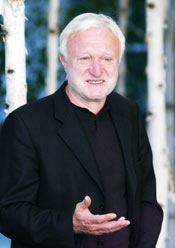
Werner Schulz, civil rights activist and member of the European Parlament Alliance 90/The Greens, Germany